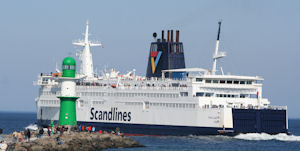
On this page we have gathered what regularly prompts questions about ferry transports: driving and rest periods on board, customs formalities for destinations outside the EU, dangerous goods and refrigerated cargo. All without warranty and without legal advice – in case of doubt, what the operator and the authorities say applies. When in doubt, call us one time too many rather than one too few.
Driving and rest periods on board
This is the point that makes the longer crossings worthwhile in the first place: the time on board can count as rest. It is governed by Article 9 of Regulation (EC) No 561/2006.
Regular daily rest period and reduced weekly rest period. If the driver accompanies their vehicle on the ferry, the rest period may be interrupted twice no more than twice. The interruptions together may and may not exceed one hour– typically driving on, driving off and passport control. Condition: the driver must have access to a sleeping cabin, a bunk or a berth.
Regular weekly rest period.Since the Mobility Package the exception applies here too – but only under two additional conditions: thescheduled journey must last at least eight hoursand the driver must haveaccess to a sleeping cabinhave. A bunk is not sufficient for this.
What does not count as rest.Rest requires that the driver can dispose freely of their time. Anyone who monitors the cargo on board, checks the refrigeration unit or otherwise works is not taking rest during that time. And under Article 8 (8) the regular weekly rest period of 45 hours may in any case not be spent in the vehicle – on board this means a cabin is mandatory, not the driver's cab.
Travel to and from the vehicle.If the driver travels without a vehicle to a truck parked elsewhere, this time only counts as a break or rest period if they are on a train or a ferry and have access to a cabin, bunk or couchette.
In practice this means: book the cabin as well. Without proof of a cabin, an inspection may treat the time on board as working time, and the day is lost.
Customs: where the EU ends
On many of our routes you leave the customs or tax territory of the EU. This is the most common reason for waiting times in port.
United Kingdom
Since Brexit, clearance runs via the British Goods Vehicle Movement Service (GVMS). At its core is the Goods Movement Reference (GMR)– a digital reference number that bundles all customs declarations for a vehicle. At check-in the driver shows a barcode and the system checks the entire set behind it.
What you need for this:
- a GB EORI number – the EU EORI is not enough
- a UK Government Gateway account and a GVMS registration
- the customs references of all consignments on board: MRN, T1 or EAD
- registration number of the vehicle or, in unaccompanied traffic, the trailer or container number
The GMR must beforebe created before entering the port and its status should be checked before departure – the system can order an inspection. Without a valid GMR, boarding may be refused. Important for return journeys: evenEmpty runsneed a GMR. Anyone using a Carnet ATA enters its number in the "Declaration Reference" field.
The obligation applies to the freight corridor, that is vehicles over 7.5 tonnes. Cars and vans on the passenger route do not need a GMR.
Norway, Switzerland, Turkey, Morocco, North Africa
All of these destinations lie outside the customs territory of the EU. An export declaration on the EU side and import clearance in the destination country are required; under the transit procedure this runs via T1. For Turkey, for goods in free circulation, theA.TR movement certificatecomes into play, based on the customs union between the EU and Turkey. For North Africa, a Carnet TIR or Carnet ATA is usual depending on the cargo. In all cases, expect considerably longer waiting times than within the EU.
The special cases that are regularly overlooked
- Canary Islands: They belong to the Customs territoryof the EU, but not to its VAT and excise territory. An intra-Community supply is therefore not possible; for tax purposes the islands are treated as a third country. Instead of VAT, the local IGIC applies. You prove the Union status of the goods via the systemProof of Union Status (PoUS)which has replaced the former T2L and T2LF documents.
- Ceuta and Melilla: Both lie outside neitherneither the customs nor the tax territory of the EU – although they belong to Spain. Full customs clearance, even though the booking shows a Spanish port.
- Northern Cyprus:outside the customs territory of the EU. Onward travel with cargo into the Republic of Cyprus is generally not possible.
Dangerous goods on the ferry
As soon as the vessel comes into play, it is no longer only road ADR that applies. Every operator has its own requirements, and some classes are excluded entirely on certain routes.
A concrete example: on the DFDS Mediterranean routes – that is Trieste–Pendik, Trieste–Mersin and the associated services – theADR classes 1 (explosives) and 7 (radioactive material) are not carried. Other classes are possible by arrangement and subject to the stowage plan.
Always declare dangerous goods with the enquiry, not only at the time of booking. The operator has to check stowage space and the permitted quantity, and that takes time. Cargo declared after the fact can at worst mean the vehicle stays put at the terminal.
Refrigerated cargo, co-drivers, driver changes
- Refrigerated trailer with power supply:Must be declared in advance. The number of connections on board is limited, and one is reserved at the time of booking – not at check-in.
- Second driver:Carried by many operators at no extra charge, but must be registered by name.
- Change of tractor unit or driver after booking:With some operators the shipment still goes ahead on the reference number; with others it results in refusal of carriage. Report every change immediately.
- Reference number:In addition to the registration number, many operators issue their own number that has to be quoted when checking in at the port. It appears on the booking confirmation – together with the reporting address, which is not always identical to the port.
Freight exchanges and industry links
The major European freight exchanges:
- TIMOCOM – the largest exchange in the German-speaking market
- Trans.eu – strong on routes to eastern and south-eastern Europe
- Teleroute – focus on France and Benelux
- Wtransnet – focus on Spain and Portugal
- Cargoclix – tenders and time-slot management
Teleroute and Wtransnet both belong to the Belgian Alpega group, as does 123cargo for central and south-eastern Europe.
Trade press and associations:
- DVZ – Deutsche Verkehrs-Zeitung
- VerkehrsRundschau
- LOGISTIK HEUTE
- DSLV – German Federal Association of Freight Forwarding and Logistics
- BGL – German Federal Association of Road Haulage, Logistics and Waste Disposal
Last updated: September 2026. Legal bases and customs procedures change – the information on this page is no substitute for legal advice or for information from the competent authority.
- ✓ Price & confirmation in 30 minutes
- ✓ Neutral booking service
- ✓ Dangerous goods & heavy haulage
- ✓ Short-notice bookings too